
 Crawvix Editorial Team
· Published October 28, 2026 · Last updated October 27, 2026 · 2 min read
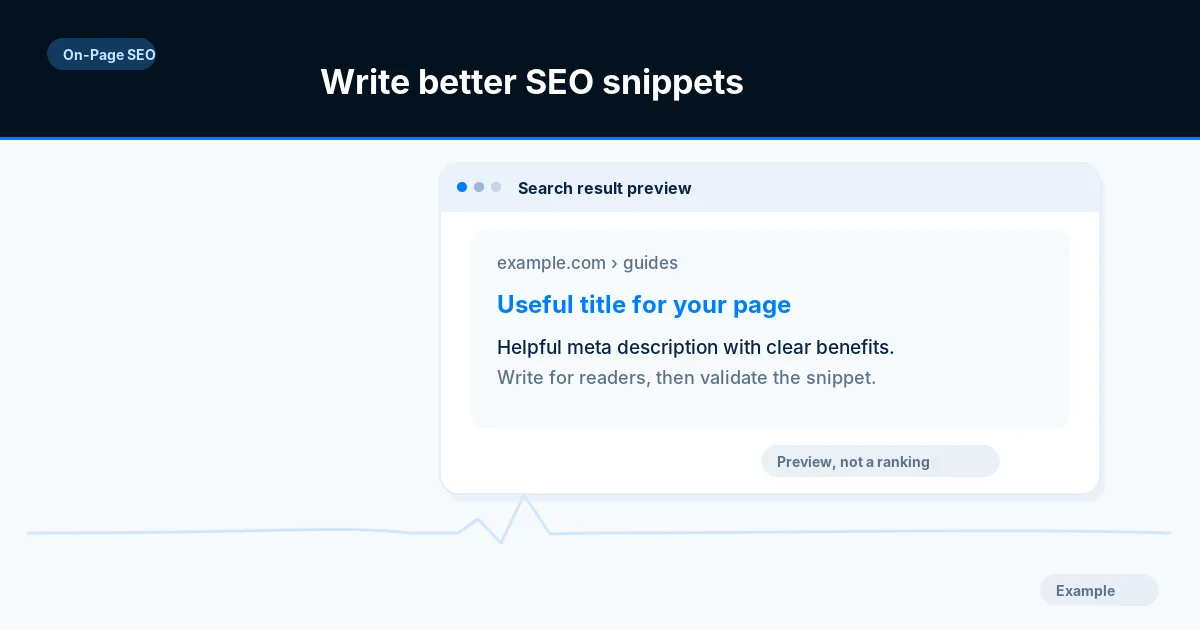
Titles and descriptions should help people understand whether a page answers their search. The goal is relevance and clarity, not mechanical keyword repetition.
Before you begin
You will need access to the website or account involved, a list of important public URLs, and permission to make the relevant changes. Save a backup of configuration before editing DNS, server rules, source code or search settings. A successful check means the specified condition was verified—not that Google or Bing will index or rank the page.
Step-by-step instructions
Step 1: Map one primary intent per page
Identify the audience and question the page solves. Review similar pages on your own site and avoid having several pages with indistinguishable titles.
What success looks like: Every indexable page has a clear purpose.
Step 2: Write a unique descriptive title
Place the meaningful topic early, then add relevant context or your brand where useful. Do not use long lists of repeated keyword variations.
What success looks like: The title accurately reflects the visible page content.
Step 3: Write a useful description
Summarize the value and next step in natural language. Search engines may rewrite snippets, so do not promise your supplied description will display every time.
What success looks like: The description remains accurate when read independently.
Step 4: Align headings and internal links
Use an H1 that matches the content promise, clear subheadings and contextual links to related guides or tools.
What success looks like: The visible content fulfills the search result promise.
Step 5: Audit templates and monitor
Detect missing/duplicated title metadata from shared layouts, then review Search Console performance over time without treating small fluctuations as causal proof.
What success looks like: Key page titles are unique and useful to actual visitors.
Final verification checklist
Every indexable page has a clear purpose.
The title accurately reflects the visible page content.
The description remains accurate when read independently.
The visible content fulfills the search result promise.
Key page titles are unique and useful to actual visitors.
Common mistakes to avoid
Stuffing target phrases repeatedly.
Duplicate titles generated by one global template.
Claiming character-count rules guarantee Google display.
Frequently asked questions
How long should my title be?
There is no guaranteed character cutoff; aim for clarity and avoid unnecessary length.
Does a meta description directly guarantee higher ranking?
No. Its primary value is to describe the page accurately and potentially improve how a result is understood.
Related guides
Official references
https://developers.google.com/search/docs/appearance/title-link
https://developers.google.com/search/docs/appearance/snippet
Next step: See how Crawvix checks a website and capture a baseline once scanning opens. This guide provides technical information, not a guarantee of rankings, 100-point Lighthouse scores or index inclusion.